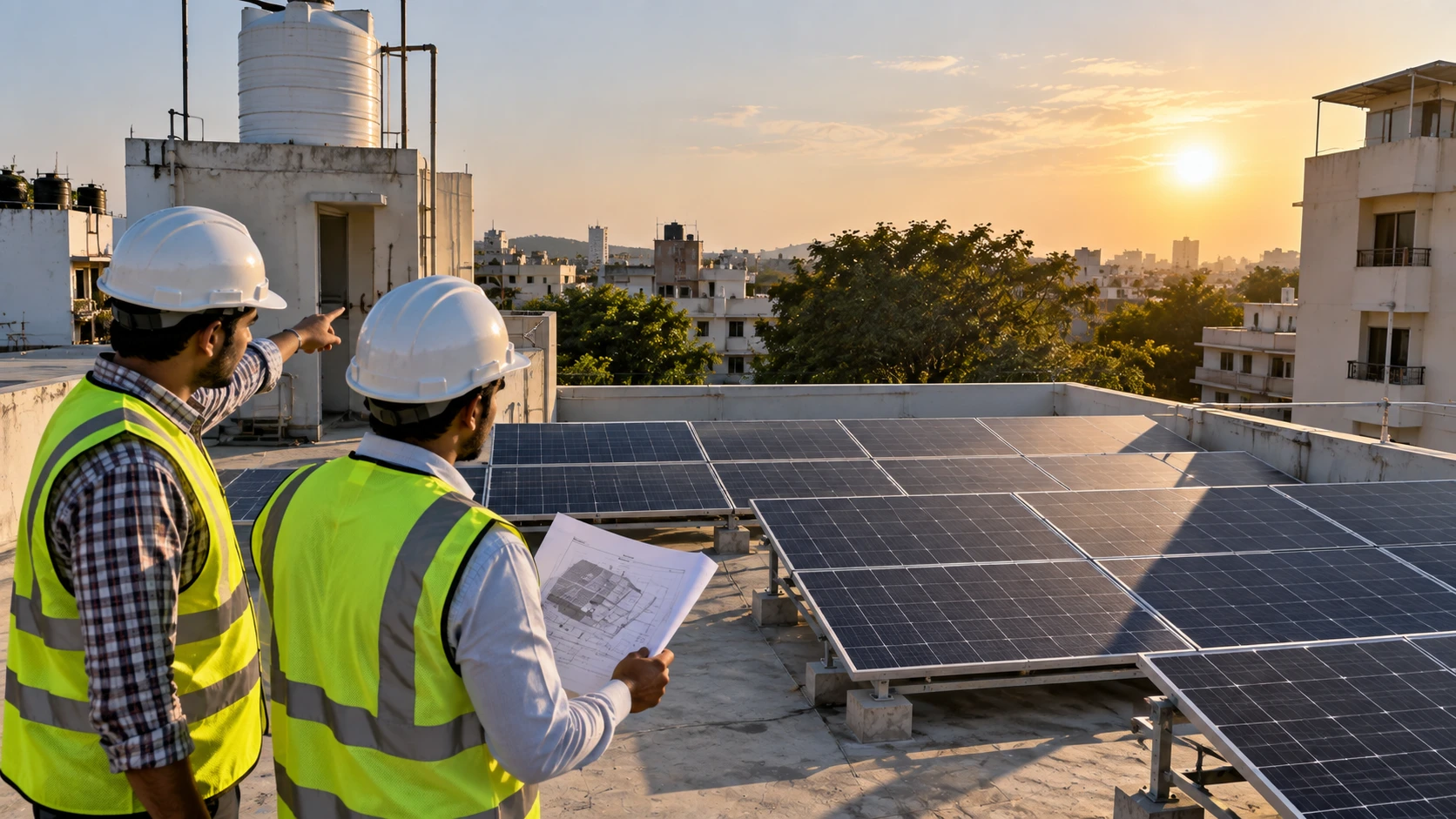
Before installing solar panels on a rooftop, factory, commercial
building, or open land, it is essential to understand how sunlight
reaches the proposed installation area. Nearby buildings, trees,
water tanks, boundary walls, chimneys, and other structures can
create shadows that affect solar energy generation.
A professional solar shadow analysis helps identify these shading
challenges and supports better panel placement, system design, and
energy-generation planning.
At Power Tech Solar Private Limited, we believe that a
successful solar project begins with proper planning. Understanding
the impact of shading is an important part of creating a reliable
and efficient solar energy system.
What Is a Shadow Analysis Report?
A Shadow Analysis Report is a technical assessment that studies how shadows from surrounding objects affect a proposed solar PV installation. The purpose of this report is to identify potential shading areas, understand how shadows move throughout the day and across different seasons, and help solar engineers determine the most suitable locations for installing solar panels. In simple words, solar shadow analysis tells you where sunlight is available and where shadows may reduce solar panel performance. A professional analysis may use site measurements, sun-path information, 3D modelling, and solar design software to study shading conditions. Depending on the project, tools such as PVsyst, HelioScope, or solar shading instruments may be used. The analysis is not limited to the current appearance of a rooftop. It also considers changes in the sun’s position throughout the year, helping engineers understand how shading may affect annual solar generation.Why Is Shadow Analysis Important for Solar Projects?
Many people assume that if a rooftop receives sunlight during the day, it is suitable for solar panel installation. However, sunlight availability can vary significantly across different areas of the same roof. A rooftop may receive direct sunlight in the morning but become shaded in the afternoon. Similarly, a nearby building may create longer shadows during winter when the sun is lower in the sky. Without proper shading assessment, a solar project may experience lower-than-expected energy generation and require design changes after installation. Here are the key reasons why every solar project should include shadow analysis.01
Helps Maximize Solar Energy Generation
02
Identifies Rooftop Shading Obstacles
03
Improves Solar Panel Layout and System Design
04
Helps Estimate Annual Solar Generation
05
Reduces the Risk of Performance Issues
06
Supports Better Return on Solar Investment
07
Useful for Residential, Commercial, and Industrial Projects
Important: No shadow analysis can guarantee a
fixed amount of electricity generation. Actual output also depends
on weather, equipment performance, maintenance, and other site
conditions.
What Does a Professional Shadow Analysis Report Include?
The contents of a shadow analysis report depend on the project type, site conditions, and analysis method. A detailed report may include the following information.1. Site Details
The report may include the project location, site information, roof details, and the proposed solar installation area.2. Shading Obstacle Assessment
This section identifies objects that may cast shadows on the solar panels, including buildings, trees, walls, water tanks, and rooftop equipment.3. Sun-Path and Shading Study
The report may show how shadows move across the proposed solar installation area during different times of the day and different seasons.4. Solar Panel Layout
A proposed layout may show suitable panel locations and areas where shading should be avoided or minimized.5. Shading Loss Estimates
Depending on the software and analysis method, the report may include estimated shading losses and their impact on solar energy production.6. Design Recommendations
The report may provide recommendations for panel placement, row spacing, string design, or other measures to reduce shading-related losses.7. Solar Generation Assessment
For many solar projects, shading results can be incorporated into energy-generation simulations and project feasibility studies.How Is Shadow Analysis Performed for Solar Projects?
The process depends on the size and complexity of the installation. A typical professional workflow includes the following steps.1
Site Survey
The solar engineering team collects information about roof dimensions, building height, surrounding structures, trees, and other potential shading obstacles.2
Identify Shading Sources
All nearby objects that may block sunlight are identified. Their height, location, and position are important for understanding their potential impact.3
Create a Solar Site Model
For complex projects, engineers may create a 3D model of the rooftop or installation site to simulate shadow movement.4
Perform Shading Simulation
Solar design software can be used to evaluate shading at different times and seasons.5
Review the Results
The engineering team reviews shading patterns and identifies areas that may experience higher shading losses.6
Optimize the Solar Layout
Based on the findings, the solar panel layout may be adjusted to improve solar access and reduce avoidable shading.7
Prepare the Shadow Analysis Report
The final report documents the findings and supports the next stage of solar project design and planning.Shadow Analysis vs. Visual Roof Inspection
A visual roof inspection and a professional shadow analysis are not the same thing. A visual inspection checks the physical condition of the rooftop and identifies obvious obstacles. A professional shadow analysis goes further by studying the sun’s position and the effect of shading on the proposed solar installation.| Visual Roof Inspection | Shadow Analysis Report |
|---|---|
| Identifies visible rooftop obstacles | Studies the impact of shading |
| Checks the physical site | Evaluates solar access |
| Usually provides a basic site assessment | Can include detailed shading simulations |
| May not assess seasonal shadow movement | Can study different times and seasons |
| Useful for initial planning | Supports detailed solar design |
What Happens If a Solar Project Skips Shadow Analysis?
Skipping shadow analysis does not automatically mean a solar system will fail. However, it can increase the risk of design problems, especially on complex or partially shaded sites.Lower-than-Expected Energy Generation
Shading can reduce the amount of sunlight reaching solar panels and may lower electricity production.Incorrect Generation Estimates
If shading losses are not properly considered, expected generation figures may be too optimistic.Poor Panel Placement
Panels may be installed in areas that receive significant shade during certain hours or seasons.Additional Design Changes
Unidentified shading problems may require layout modifications or other corrective measures after the initial design.Reduced Customer Confidence
When actual solar generation does not match expectations, it can lead to customer dissatisfaction.Shadow Analysis for Solar Projects in India
India receives abundant sunlight in many regions, making solar energy a strong option for residential, commercial, industrial, and agricultural applications. However, Indian rooftops can also present unique shading challenges. In cities and industrial areas, solar panels may be affected by:- Closely spaced buildings
- Rooftop water tanks
- Parapet walls
- Trees
- Industrial equipment
- Adjacent structures